

The pressure on financial institutions is no longer to explore AI, but to show what it can actually deliver.
The pressure on financial institutions is no longer to explore AI, but to show what it can actually deliver.

From Pilots to Something More Permanent
Financial institutions have spent recent years experimenting with AI. Investment has grown as new pilots have been launched to test use cases. What is shifting in 2026 is the expectation attached to all of that activity. This year is increasingly framed in industry analysis as a defining period for banks, one in which the question is no longer whether to pursue AI but whether the conditions exist to make it work at enterprise scale.
Many institutions are under pressure to move beyond isolated projects, and what separates those that do from those that stall is unlikely to come down to the technology itself.
Five conditions are emerging as likely predictors of durable AI success in financial services.

A Business-Led Value Agenda
AI initiatives anchored in technology for its own sake tend to produce results that are difficult to measure and harder to sustain. Industry analysis of AI in banking points to a consistent pattern. Leading institutions anchor AI initiatives in clear business outcomes and involve business leaders from the outset, rather than leaving isolated use cases to independent technology teams.
This distinction matters in financial services because the sector operates across functions where AI's relevance is real but only if the business context shapes the design. Technology teams building in isolation from the problems they are meant to solve tend to produce pilots that work in controlled conditions, but struggle to move the metrics that boards and executives are watching.

Data Foundations That Are Actually Ready
This is arguably where many financial institutions face the most immediate friction. Industry analysis is direct on this point, many banks' AI ambitions are being constrained by brittle and fragmented data infrastructure, and data readiness remains uneven across institutions.
The stakes here go beyond operational performance. In financial services, data quality and timely availability is becoming a regulatory expectation, particularly in risk and financial crime contexts, not simply an internal standard institutions set for themselves. A bank can have access to sophisticated models and still produce outputs that are not reliable enough to act on if the underlying data is poorly maintained or difficult to access. Data readiness in financial services has direct implications for model performance and regulatory exposure, along with shaping whether the people expected to use AI outputs have any confidence in what they are being shown.

Governance That Can Keep Pace With Scale
Governance is often framed as a constraint on AI progress. In practice, the evidence points the other way. Research into enterprise AI consistently describes governance as the difference between scaling successfully and stalling out, and notes that organizations where senior leadership actively shapes AI governance tend to achieve greater business value than those that delegate it to technical teams alone.
In a regulated industry like banking, governance cannot exist as a parallel track alongside AI deployment. It needs to be woven into the risk and oversight structures that already govern the institution. Effective governance integrates with existing risk frameworks rather than functioning as a separate structure running alongside them. For financial institutions in particular, that integration is what makes broader AI adoption viable within the constraints regulators expect.

An Operating Model Built Around Adoption
Much of the discussion about AI in banking centers on what the technology can do. Less attention tends to go to whether the organizational conditions are in place for people to actually use it. Industry analysis makes the case that capturing value from AI requires the organization itself to change, not just the tools it uses, from the operating model and talent structure to data flows and tracking mechanisms.
This often means breaking down the functional silos that prevent AI tools from being used consistently across the business. Cross-functional teams and coordinated approaches to AI deployment are increasingly identified as ways institutions can track value realization and prevent the fragmentation that tends to accompany large-scale rollouts. Adoption has to be designed for.

Talent and the Human Layer
AI in financial services does not operate without people, and the gap between ambition and execution frequently shows up here. Talent shortfalls across technical and compliance roles remain a persistent challenge for financial institutions pursuing AI at scale. However, successful AI scaling goes deeper than just being a hiring question. It involves building AI fluency across the workforce, alongside maintaining active human oversight as AI takes on more of the work.
In a sector where the consequences of errors can be significant and regulatory scrutiny is constant, human judgment remains a meaningful part of how AI is deployed responsibly. This is not an argument against AI capability. It is a recognition that in financial services, how people understand and work alongside AI systems is part of what makes those systems trustworthy enough to scale.
What 2026 Is Actually Testing
The financial services industry is not short of enthusiasm for AI. What 2026 appears to be testing is something different, whether that enthusiasm is backed by the organizational conditions needed to turn AI into repeatable, trusted value.
Business alignment, data readiness, governance, operating models, and talent are not new ideas. What is new is the clarity with which current industry analysis is pointing to them as the factors that will likely determine which AI efforts in banking mature into durable capability, and which ones remain well-intentioned experiments.
Manually Vetting Vendors? Save Time, Reduce Risk, & Stay Compliant
Dun & Bradstreet’s Vend-R platform delivers verified, risk-rated vendor profiles in one place, cutting vetting time, supporting compliance standards, and helping you avoid exposure to unreliable or noncompliant suppliers.

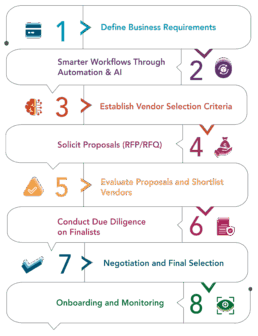
A clearly defined vendor selection process helps corporations reduce uncertainty and make informed, high stakes decisions with confidence. By following these key steps, from defining business needs to onboarding and monitoring, organizations can ensure that each vendor relationship is built on a foundation of due diligence, strategic fit, and long term value. In the next blog, we’ll explore how to optimize these processes further by embedding best practices that improve efficiency, compliance, and performance across the procurement lifecycle.